Deployment governance
May this AI service operate in the approved environment?
The action-clearance and proof layer
TrustGate Sovereign binds enterprise authority to one exact action against a protected target. The protected target verifies that clearance before state change; TrustGate then closes the authorization against what actually happened—including acceptance, rejection, ambiguity, reconciliation and recovery.
It complements deployment, model, platform, identity, policy and operational controls. It does not treat a governed AI service as authority for every action.
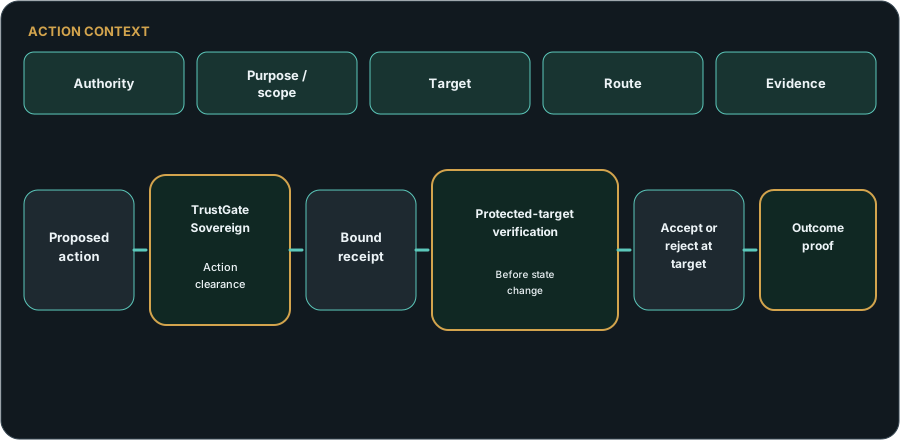
A decision alone is not execution authority. The protected target verifies the clearance before accepting a state change.
The missing control layer
Deployment, model and platform governance remain necessary. Identity, policy and operational controls remain necessary. But none of those layers automatically authorizes one exact action against one protected target in its current context.
May this AI service operate in the approved environment?
Are the model, tools and agentic environment governed?
May this exact action, under this authority, follow this route to this target now?
Does the target verify the same clearance against current external reality before it changes state?
TrustGate adds the missing exact-action control layer. It does not replace the governance layers around it.
How it works
A consequential action is proposed. TrustGate evaluates the enterprise authority for that exact action and binds an accepted decision into a clearance receipt. The protected target verifies that clearance before accepting a change, and the resulting outcome is preserved as evidence.
The public chain shows the control principle. Receipt semantics, verification mechanics and implementation contracts remain controlled.
Authority bound to action
The decision travels with the context that makes it meaningful. TrustGate connects who is accountable, what is intended, where the action would go, what evidence supports it, which policy applies and what outcome follows.
These are public context categories, not a publication of TrustGate’s private authority contracts or proof schemas.
External reality
TrustGate can clear one exact action, but the protected target must still verify that the clearance matches the requested action, route, target and current context before accepting a change.
Authority and policy are evaluated for one exact proposed action.
The target verifies the clearance against the action and current external reality.
The action is not treated as cleanly complete; rejection or ambiguity remains visible for review.
A decision alone is not execution authority.
Public evidence is limited to bounded synthetic reference scenarios. No production enforcement, customer deployment, cross-process security guarantee or enterprise-wide non-bypassability is claimed.
Closing the action
The control chain accounts for what the protected target actually did, not only what the decision permitted. Authorization closes only when the external outcome is confirmed—or remains explicitly ambiguous, in reconciliation or in recovery.
Preserve reviewable evidence of acceptance, rejection and the resulting target state where the bounded path can show it.
Keep an uncertain or incomplete external result explicit instead of silently treating it as success.
Carry unresolved state into controlled review and record how the outcome is reconciled or recovered.
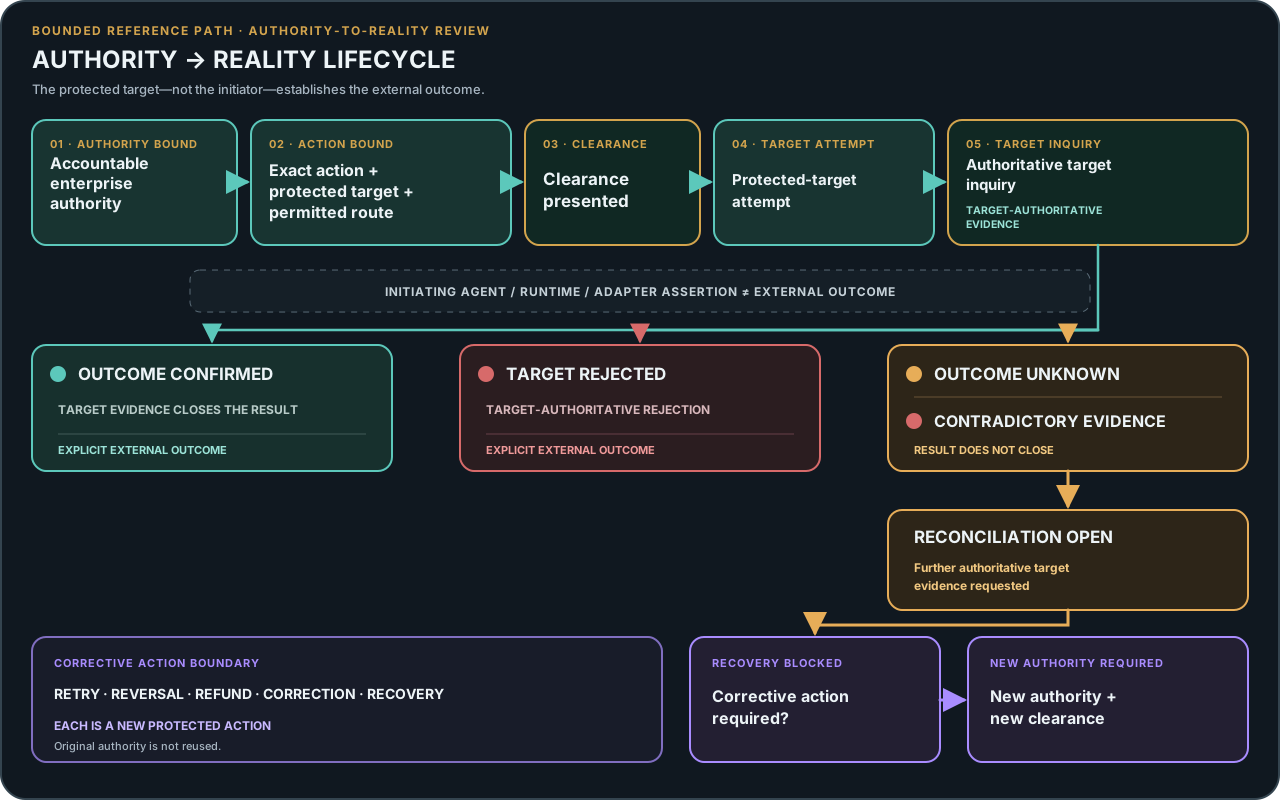
The public page describes the control model. It does not claim a universal automated rollback, reconciliation or recovery mechanism.
TG360
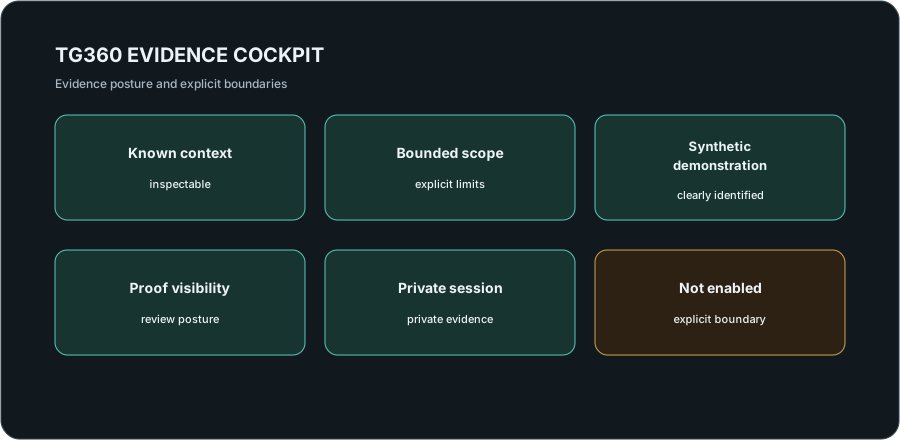
TG360 is the buyer-facing evidence cockpit for a private walkthrough. It makes the bounded review posture visible while TrustGate remains the action-control layer.
In the bounded reference path, TG360 can also show whether the reference target changed or remained unchanged after an accepted or rejected action. It presents evidence; it does not become a second decision engine.
Where the pattern applies
TrustGate is organized around an action-control pattern, not a single sector or vendor stack. Each real action, protected target and integration boundary must be assessed.
Control paid tools, services and payment actions before value is committed.
Apply exact-action authority where AI would change regulated workflows, records or operational state.
Treat data systems, business applications and external APIs as protected targets once their action and verification boundaries are assessed.
Preserve authority when plans cross systems, tools or specialist agents with different scopes.
A bounded path to adoption
Early review can begin without customer production data. A real pilot still requires a defined use case, a target-pattern assessment and customer-specific integration and deployment work.
Align the buyer problem, action boundary, authority model and evidence questions.
Inspect the clearance and target-verification pattern without using customer production data.
Evaluate the real action, route, target, context and integration boundary.
Agree the use case, evidence, success boundaries, responsibilities and limitations.
Build and validate the customer-specific path required by the assessed target.
Move beyond pilot only when the implementation and its evidence satisfy the customer’s technical, security, risk and operational acceptance gates.
The TrustGate core remains distinct from customer-specific work. Repeated target patterns may create reusable adapter and deployment knowledge, but reuse is assessed—not assumed. No universal zero-code integration, every-target support or automatic production readiness is claimed.
Controlled disclosure
The homepage explains the buyer problem, control principle, evidence posture and adoption path. Deeper proof is shown in the right review setting, and security-sensitive implementation detail stays private.
Source code, proof semantics, private contracts, verification internals, credentials, topology and customer designs are not public homepage content.
Founder and contact
Pedro Barbas is the founder and architect of TrustGate Sovereign. Private architecture walkthroughs are available for enterprise leaders and technical, risk, security, resilience and governance teams evaluating consequential agentic AI actions.
Start with the action that matters, the authority it requires, the target it would change and the evidence your organization would need to accept the next step.